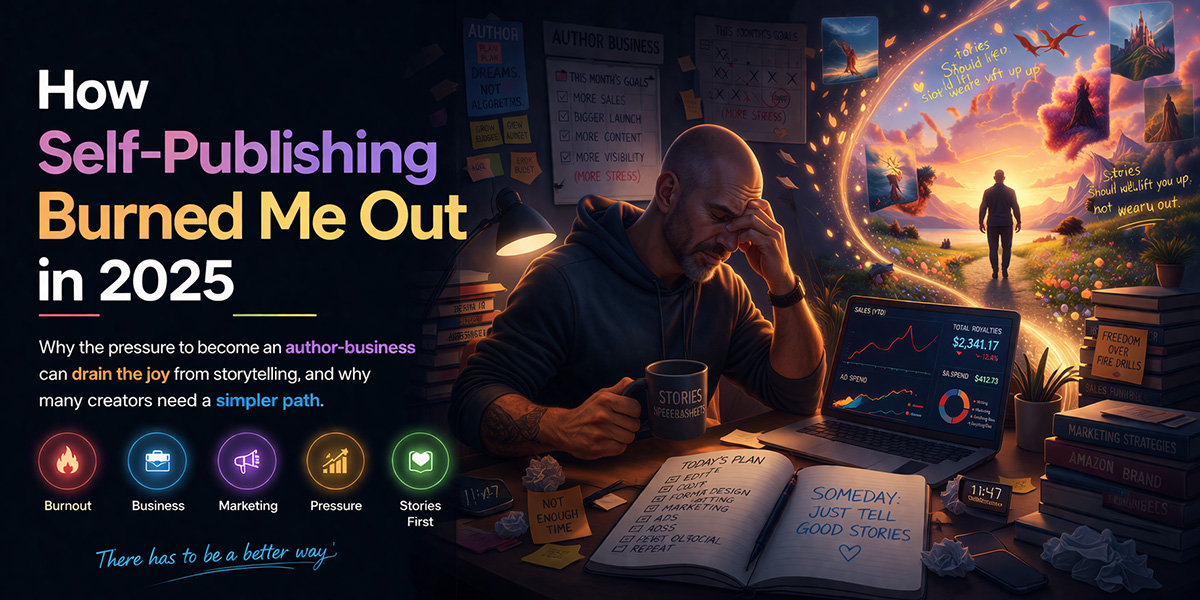
How Self-Publishing Burned Me Out in 2025
Why the pressure to become an author-business can drain the joy from storytelling, and why many creators need a simpler path
There is a lie self-publishing tells very well.
Not always explicitly. Not in some grand conspiracy. More by atmosphere. By repetition. By the collective weight of advice, aspiration, and endless tactical content.
The lie is this:
If you really care about your stories, then sooner or later you should also want to become a publishing business.
Not just a storyteller. That would be far too simple.
You should want to become a brand. A marketer. A launch strategist. A newsletter builder. An ad buyer. A metadata optimiser. A student of retailer algorithms. A producer of social content. A manager of funnels. A curator of lead magnets. A keeper of automations. A person who somehow still has enough spiritual stamina left over to write the actual books.
This, we are told, is freedom.
And for some people, perhaps it is.
For me, by late 2025, it had become something much closer to slow psychological erosion.
Not because self-publishing was the only problem in my life. It wasn’t. That would make for a cleaner article, but reality is rarely so obliging.
The truth is more boring and more common.
I had a stressful day job. A financially necessary one, which is the worst kind to resent. It paid the bills. It helped support more than one household. It carried responsibilities I couldn’t simply walk away from because I’d had a poetic revelation about the importance of art. Life, unhelpfully, kept demanding to be funded.
And then there was everything else. The pressure. The overcommitment. The sense that I was always trying to do one thing too many, carry one goal too far, hit one target too ambitiously. I was disappointed in myself more often than was healthy. I was exhausted in that modern, respectable way where you still function well enough to pretend you’re fine.
Until you aren’t.
In late autumn 2025, something in me got dangerously close to breaking.
It was not theatrical. No grand moment. No dramatic collapse in a rainstorm while violins played somewhere in the distance. Just the far less glamorous reality of a mind and body that had spent too long under too much pressure and had finally started objecting in earnest.
It was messy. It was private. Most people didn’t know the full extent of it.
And one of the more uncomfortable truths buried inside that mess was this: self-publishing had become part of the strain not because I hated it, but because I had hoped too much from it.
That is what made it dangerous.
Because from 2016 onwards, self-publishing had quietly become more than a hobby in my mind. It had become an imagined route out.
I found writing fiction by accident, really. A plane to Berlin. Boredom. A scene arriving in my head. Then another one on the flight back. Then a few more ideas. Then the absurd and irresistible thought: maybe I could write a book.
I had never written a novel before. I had no idea how the industry worked. I barely understood the terminology. Then I discovered KDP. Then the wider indie world. Then the communities, tools, software, services, courses, podcasts, articles, advice threads, success stories, cautionary tales, and all the paraphernalia of a modern self-publishing ecosystem that can make you feel both inspired and faintly inadequate within the same ten-minute period.
At first, it was thrilling.
And why wouldn’t it be? Here was a route by which someone with stories in their head could bring them into the world without waiting for permission from New York, London, or anyone else seated behind a desk with an opinion.
That mattered to me deeply.
But over time, something more emotionally loaded happened. I started to believe, perhaps not consciously at first, that this might be the thing that eventually allowed me to leave behind the parts of my professional life that felt draining, unrewarding, and increasingly disconnected from the kind of work I actually wanted to do.
Self-publishing became, in my head, a bridge.
A bridge from stress to meaning.
From obligation to creativity.
From “what pays the bills” to “what feels alive.”
That is a powerful dream. Powerful enough, in fact, to keep a person going for quite a long time.
Powerful enough also to do damage when it stops looking plausible.
Now, I should say this clearly: I am not afraid of hard work.
This is not the article of a man who wanted easy money and was offended to discover that effort was required. I like hard work when it is attached to the right things. I like building. I like inventing. I like momentum. I like taking complicated ideas and shaping them into something real. I like challenge. I like problem-solving. I like the big-picture stuff, the visionary stuff, the creative architecture of making something from nothing.
What I do not like is endless task-churn in service of systems that do not feed that part of me.
And that was the problem.
My day job had increasingly become dominated by exactly the kinds of work that drain me most: operational pressure, short-term delivery, small-box thinking, endless task management, the management of moving parts for the sake of moving parts.
Then, with some horror, I realised that my self-publishing life was starting to look very similar.
That was the sting.
The thing I had built up in my mind as the escape route was quietly turning into another version of the same trap.
Because modern self-publishing, at least in the way it is commonly presented, is not just about writing stories.
It is about building and running a system around writing stories.
Need to write the book? There are plotting tools, outlining frameworks, worldbuilding apps, drafting systems, writing communities, editing tools, grammar checkers, productivity software, AI assistants, beat templates, story coaches, and enough instructional content to make you feel as though writing a novel now requires the workflow stack of a medium-sized software team.
Need to publish the book? Add cover designers, formatters, blurb specialists, launch strategists, metadata advice, category games, retailer rules, platform choices, and various people online who are absolutely certain your career would be flourishing if only you had understood the importance of subtitle hierarchy.
Need readers? That is where the real machinery begins.
Now you need a website. A mailing list. A reader magnet. A lead magnet. A sign-up flow. A welcome sequence. Social channels. Content plans. ARC teams. Paid promos. Cross-promos. Ad campaigns. Analytics. Brand consistency. Reader retention. Platform strategy. Freebook stacks. Newsletter swaps. Launch timing. Follow-up offers. Endless visibility work.
And all of it carries the same message: more effort, more learning, more time, more cost.
Very little of it is the story itself.
That is the heart of the problem.
You come because you want to tell stories.
You stay, increasingly, because you are managing an ecosystem.
And perhaps that trade-off makes sense if your true ambition is to build a serious author business. For some people, it clearly does. Some authors are brilliant operators. Some enjoy the game. Some thrive in the overlap between art, commerce, data, and systems.
I do not begrudge them that for a second.
But I think an enormous number of people have drifted into self-publishing under a completely different motivation.
They do not want to build a publishing business.
They want to bring stories to life.
That distinction matters more than the industry likes to admit.
Because most people in this space are not doing it full time with endless resources and a clean runway. They are doing it around jobs. Around children. Around relationships. Around tiredness. Around lives already groaning under the weight of practical obligations.
Their time is limited.
Their money is limited too.
Their mental energy may be the rarest resource of all.
And if that is true, then every extra layer of tactical complexity matters.
Every subscription.
Every new learning curve.
Every platform.
Every expectation that “serious” creators must also become part-time experts in adjacent fields they never asked to join.
At some point, the cost stops being abstract.
It becomes personal.
That is what happened to me.
And what made it harder was that I could see I was spending increasing amounts of my limited non-work time not on the stories themselves, but on everything surrounding them. Websites. Promotions. Systems. Strategy. Platform thinking. The long administrative tail attached to the act of putting fiction into the world.
All of this in service of an imagined future where it might eventually add up to escape.
But as that future kept receding, and the effort kept accumulating, the whole thing became harder to emotionally justify.
Then I hit the wall.
And once I had, I did what I should probably have done much earlier: I simplified.
That process deserves its own piece, but the short version is that I started trying to remove needless complexity from my life. Not all pressure. Not all work. Just the extra layers that were stealing time, headspace, and joy without returning anything proportionate. I tried to spend more time with family. More time inhabiting the place I live in southern Spain rather than merely passing through it on the way to the next obligation. More time existing like a human being instead of an overloaded task management system with legs.
And then, once I’d made some room, something interesting happened.
My imagination came back.
Not tentatively. Not politely. It came back like it had been waiting behind a locked door with a battering ram.
Story ideas started arriving everywhere. Walking. Driving. Shopping. Commuting. Halfway through completely unrelated thoughts. Premises, worlds, characters, twists, emotional setups, story structures. It was as though the creative side of me had survived the whole mess and now wanted to remind me that it had not, in fact, gone anywhere.
So there I was again, facing the familiar problem:
I wanted to bring these stories into the world.
Only now I knew I did not want to go back through the same traditional self-publishing grind to do it.
So I looked seriously at AI.
I used it properly, not casually. I wrote a spicy romance novel over about three months, and around sixty percent of the raw content was AI-generated. It exists. It is on Amazon. It sits under a pen name I do not disclose, partly because I prefer to keep at least some corners of my life free from immediate public experimentation.
And what I learned from that process was useful.
I liked the world. I liked the underlying structure. I liked the characters. I liked the taste behind it. But the prose itself was bloated, overcooked, and too full of AI-isms to feel genuinely alive. It had the familiar problem of sounding almost right while somehow draining energy from every page. As a reading experience, I would probably rate it a three out of ten, which is not a score that inspires one to trumpet success from the rooftops.
That was clarifying.
Because it showed me that the answer was not simply, “Use AI and become a faster version of the same kind of author.”
That still felt like the old model. Still a book-production mindset. Still built around the assumption that the goal is to become a writer-producer of finished market objects, whether by hand or with assistance.
But the question forming in my head had changed.
What about people who just want to create stories?
Not careers. Not brands. Not optimised publishing businesses. Stories.
People with deep taste as readers. People with worlds in their heads. People with story ideas, emotional instincts, strange combinations, niche obsessions, and the desire to make something exist that does not yet exist.
People who are not asking, “How do I build my author platform?”
People who are asking, “How do I bring this thing in my head to life?”
That, to me, is the gap.
And yes, there are already social storytelling spaces. Wattpad. Royal Road. Fanfiction platforms. Community-driven ecosystems where stories are discovered through comments, lists, fandoms, recommendations, niches, and shared enthusiasm rather than simply sitting on digital retailer shelves waiting to be purchased.
Those platforms matter. They prove that storytelling has already escaped the old bookshop model.
But they still generally assume one crucial thing: someone has to write the thing in full.
And writing the thing in full still takes a great deal of time, discipline, and production effort.
At some point I realised that the identity which suited me best was not simply “writer” as the current market defines it.
It was something more like story architect. Story engineer. Story producer.
Someone with a ridiculous backlog of ideas and a strong desire to get far more of them into the world than the traditional routes would ever realistically allow.
I have hundreds of story ideas saved across devices, hard drives, notes apps, documents, and half-forgotten files.
If I try to produce them all through conventional pathways, I will get perhaps one percent of them into existence before I die, which seems, frankly, a terrible conversion rate.
And the moment I saw that clearly, the larger idea became obvious.
There must be many more people like me.
People who are imaginative, story-driven, comfortable with AI, rich in taste, short on time, and not especially interested in becoming publishing moguls just to share what they have inside them.
And there was no tool built properly for them.
So I decided to build one.
That is why I am building StorySparx.
Not because I think writers should stop writing.
Not because I think craft no longer matters.
Not because I think books are obsolete.
Because I think the current routes are too narrow for the range of people who want to tell stories.
Maybe you never wanted to become an author-business.
Maybe you never wanted your creative life to turn into ad dashboards, mailing sequences, metadata tweaks, and a second unpaid career in self-promotion.
Maybe what you wanted was much simpler than that.
Maybe you just wanted to bring your stories to life.
If that sounds familiar, then you are exactly who StorySparx is for.
I am not offering this as a detached observer with a tidy theory. I have spent years on the wrong roads. I know what it feels like to hope self-publishing will become your way out, only to discover that the version on offer asks you to become something you never actually wanted to be.
So I am not the hero here.
You are.
You are the person with imagination. The person with ideas, worlds, characters, scenes, premises, moods, and obsessions worth sharing. The person who has something inside them that wants to exist.
My role is simpler.
I am the guide who has walked the long, overcomplicated roads and is trying to build a better one.
StorySparx is meant to help people like you bring stories into the world without first having to become a full-scale author-brand, publishing operator, or exhausted content machine.
You bring the spark. The concept. The taste. The emotional truth. The thing in your head that refuses to leave you alone.
StorySparx helps shape it, build it, and connect it with readers who are hungry for stories.
Because your real need is not “I need a more efficient publishing workflow.”
It is much deeper than that.
It is: I want this thing inside me to exist.
I want to express it.
I want to make something that feels like mine.
I want other people to experience it.
I want to take part in storytelling, not just watch from the outside.
That is the need I want StorySparx to serve.
Not by turning you into a better operator.
By helping you become what you already are.
Someone with a story to share.